
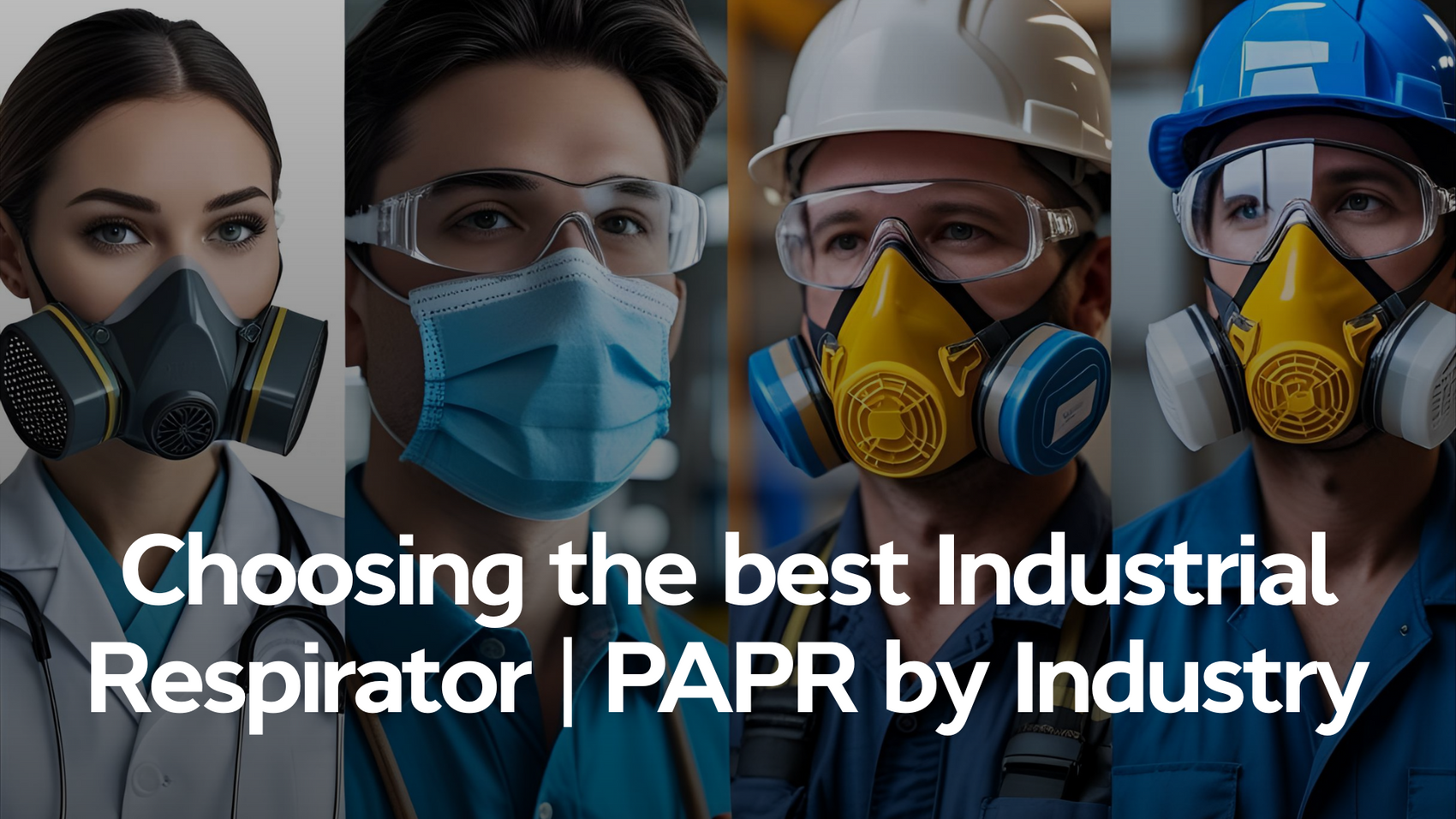
In today’s diverse work environments—from healthcare to mining, painting to chemical manufacturing—choosing the right respirator or PAPR (Powered Air-Purifying Respirator) is critical. Every industry has unique respiratory hazards and regulatory demands. This guide will help you select the most suitable equipment for your domain.
1. Understanding Respirator Types & Protection Levels
N95 Respirator
-
Disposable filtering facepiece, certified by NIOSH to filter ≥95% of particles ≥0.3 µm.
-
Provides an Assigned Protection Factor (APF) of 10 when properly fit tested.
-
Commonly used in healthcare, construction, and general industrial settings.
Half‑Mask / Full‑Face Respirators
-
Reusable masks with replaceable filters (P100, gas/organic vapor cartridges). Made of silicone, neoprene, EPDM, and more.
-
APF ranges from 10–50, depending on design and fit.
-
Excellent for painting, chemical processing, demolition, and reuse scenarios.
Powered Air-Purifying Respirators (PAPRs)
-
Battery-powered blower filters incoming air through cartridges (particulate, chemical, or both) and delivers clean air via a hood or mask.
-
APF ranges from 25 up to 1000 depending on design (hood vs elastomeric). Loose‑fitting hood PAPRs APF ~25–50; hard‑hat or full‑face elastomeric PAPRs can reach 1000.
-
Ideal for users who cannot pass fit tests, have facial hair, or need extended wear comfort.
Supplied Air Respirators (SARs) & SCBA
-
SARs: Air-supplied units from an external clean-air source. APF 10–2000.
-
SCBA: Self-contained air supply tanks, APF up to 10,000—used in IDLH (Immediately Dangerous to Life or Health) environments.
2. Respirator Selection Logic: Fit, APF & Hazard Matching
-
Fit testing is mandatory for tight-fitting respirators; user seal checks are essential every time they're donned. Facial hair, scars, or improper fit drastically reduce protection.
-
APF must meet or exceed the hazard factor, which is the ratio of contaminant exposure to permissible limits—especially when multiple substances are present.
-
For IDLH, only SCBA or pressure-demand SARs are permissible. PAPR is acceptable when conditions are below IDLH but above permissible limits.
3. Keyword-Rich Industry‑Specific Guidance
| Industry PAPR / Respirator | Best Industrial Respirator | Why It Works? |
|---|---|---|
| Industrial respirator / Manufacturing PAPR | Reusable or full‑face respirators; PAPR | Protects from welding fumes, dust, and solvents. Reusable filters and high APF offer comfort and protection during long shifts. |
| Healthcare PAPR / Surgical N95 / Healthcare respirator | N95 or surgical N95; healthcare PAPR | Filters airborne pathogens effectively. PAPR models accommodate facial hair and reduce breathing resistance, ideal for labs and pandemic response. |
| Construction respirator / Construction PAPR | N95 or elastomeric respirator with particulate or P100 filter | Highly effective for silica dust and particulates. Meets OSHA fit-testing requirements and provides reliable on-site protection. |
| Painting respirator / Painting PAPR / Vapor cartridge respirator | Organic vapor cartridge respirator or full‑face PAPR | Designed to protect from solvents, isocyanates, and harmful vapors. PAPR offers better airflow and comfort during extended use. |
| Chemical respirator / Chemical PAPR / Acid gas respirator | Full‑face elastomeric with chemical cartridges or PAPR | Offers strong protection from acid gases and organic vapors. PAPR reduces user fatigue while ensuring high filtration efficiency. |
| Mining respirator / Mining PAPR / Underground respirator | Full‑face respirator or PAPR | Filters fine dust, silica, and toxic gases found in mining environments. High APF models are preferred for underground safety. |
| Firefighter SCBA / Emergency response respirator | SCBA or pressure-demand SAR | Required for IDLH environments. Provides independent air supply crucial for emergency responders and firefighting professionals. |
| Lab respirator / HEPA respirator | PAPR with HEPA filters; full‑face chemical cartridge setup | Ideal for long-duration lab and biosafety work. Offers protection from aerosolized biological agents and chemical hazards. |
4. Step‑by‑Step Respirator Selection Process
-
Identify hazards: dust, particles, gas, vapor, aerosol, biological.
-
Check exposure level vs OSHA/NIOSH PEL/OEL or IDLH.
-
Determine APF requirement to reduce exposures below hazard factors.
-
Assess wearer factors: facial hair, comfort, shift length.
-
Choose respirator type: N95 for low particulate exposures; elastomeric for particulate or gas; PAPR for high comfort or fit limitations; SCBA/SAR for IDLH environments.
-
Fit test and train according to OSHA/NIOSH standards.
-
Maintain and inspect reusable respirators and PAPRs regularly. Disposable filters have defined shelf life and recommended replacement cycles.
5. Real-World Application Examples & References
-
In chemical operations and painting, we advise using chemical respirator filters and cartridges or a PAPR (often equivalent in protection to SAR) when processing isocyanates or VOCs like those found in coffee processing or coatings applications.
-
For high-risk settings like CBRN or infectious disease environments, certain PAPR systems deliver mobility and sustained protection—ideal for military, law enforcement, and healthcare professionals responding to hazardous exposures.
Key Takeaways
-
Start with the hazard: check contaminant type and concentration.
-
Determining APF is vital to ensure sufficient protection.
-
Prioritize fit testing—especially for N95s and elastomerics.
-
PAPRs are best when comfort or fit is a concern, or for extended wear in high-exposure zones.
-
SCBA/SAR is the only choice in IDLH or oxygen-deficient environments.
Final Thoughts
This guide brings together essential insights and high-demand keywords such as industrial respirator, healthcare PAPR, painting respirator, mining PAPR, and more—serving as a comprehensive resource for selecting the right respiratory protection across various industries.
By aligning product recommendations and usage considerations with authoritative standards from trusted sources like OSHA and NIOSH, it ensures both practical relevance and compliance with industry best practices. Whether you're safeguarding workers in healthcare, mining, manufacturing, or industrial environments, this framework helps identify the most suitable PAPR or respirator solution tailored to your operational needs
